
Thursday, May 16, 2013
Wednesday, April 3, 2013

Tuesday, January 22, 2013
CINECITY_2013

FILM COMPETITION 2013
2013_Co-curators Sarah Breen Lovett & Louise Mackenzie
The CINECITY workshops have been run collaboratively in Melbourne & Sydney by architects and film makers. The participants make one minute films exploring spatial ideas.
The CINECITY workshops have been run collaboratively in Melbourne & Sydney by architects and film makers. The participants make one minute films exploring spatial ideas.
The CINECITY workshop &; exhibitions were established in 2009 by Louise Mackenzie, Romaine Logere, Russell Bywater, & Foo Chi Sung (Fooch) director - squint/opera/australia
Further Info for 2013:

CINECITY_2011
CINECITY 2011 Exhibition and Panel Discussion
Australian Institute of Architects National Conference: Natural Artifice
Exhibition
14 April to 16 April 2011
Panel discussion
16 April 2011 @ 1.10pm Room 112
Juhani Pallasmaa
Michael Tawa (University of Sydney)
Richard Sawada (ACMI)
Des Smith (Deakin University)
Fooch (Squint Opera)
Daniel Flood, Sam Slicer (Flood & Slicer)
Chair: Sarah Breen Lovett (University of Sydney).
With thanks:
the Panellist, the Guest Crits, Louise Mackenzie,
Russell Bywater,
Sarah Breen Lovett, Seung Hyuk Choi & Janet Renehan
VIEW THE PANEL DISCUSSION:
VIEW FILMS HERE:


"IT'S A KENNEDY": Melbourne, the Cinema and the work of Chris Kennedy.


Architect Victoria Spring 2008
Australian Institute of Architects
Victorian chapter
“It’s a Kennedy”: Melbourne,
the Cinema and the work of Chris Kennedy.
Culture and place are intertwined in ways that don’t make them
easy to separate, especially in terms of our experience of them. If we look at
the cinema we see this subject constantly addressed. We’ll also see that there is a constant
exchange between our stories and those stories we see reflected on the screen.
Chris Kennedy is a production designer, who over the last twenty
years, has worked on many Australian films, including GHOSTS…OF THE CIVIL DEAD
(1988), DEATH IN BRUNSWICK (1989), SPOTSWOOD (1992), STIFF (2004) and THE BRUSH
OFF (2004), all of which were set in Melbourne.
In these films we see images of Melbourne that we are familiar with. The
representations of place connect us to the film and the films back to us. This
happens through the cityscapes, and also
in the rooms, pictured in these films, which show the way(s) we live. David
MacDougall in his book TRANSCULUTRAL CINEMA writes that, “tacit knowledge” is
that knowledge which,
“…we can not “tell” in the abstract;
it is knowledge we can only convey by showing – by expressing our relation to
it in a manner that allows others to enter into a similar relation to it”(29).
It may be that the descriptions of place contribute towards
defining place for us in that the choices made for locations and sets created -
the spaces and places created by the production designer, in some way distils
Melbourne for us. Perhaps they “pick
out” the quintessential bits of Sydney Road, (in STIFF) for example, that we
readily recognize as Sydney Road – and by doing this it defines what it is
about Sydney Road – that makes it Sydney Road
- and by us recognizing it, makes us (in some way) a part of it.
GHOSTS…OF THE CILVIL DEAD
is not for the most part set in Melbourne. The film is slow and
menacing. It’s set in a prison (out in
country). Nick Cave in an interview, on
the DVD for the film, says that the main character in the film is the prison
itself. The set that Chris Kennedy created in this film results in an
environment that is extremely oppressive: for the prisoners and the guards
alike. The film ends at Parliament
Station connecting it directly (and terrifyingly) back to us. (It’s our story
too.) This is one of the points the
creators of this film are making - you can’t lock people away in harsh
environments without involving the whole society. This closing scene is very effective use of
place in storytelling. The film makers suggest through the use of space (in
part at least), that the desperate nature within the prison is deliberately
created, by those in control, those who remain unseen: those who own the prison
and the government who legislates: the people responsible for the creation of
this, particular space.
“It’s a Kennedy” is a line from THE BRUSH OFF (filmed for the
most part in and around Melbourne’s - arts precinct). The “Kennedy” they are
referring to is – a work of art, a sculptural piece, in the gallery, with in
the film, (which is actually ACCA). It
is funny in part because, not only this piece but the whole film is a Kennedy. By
referring to the work in this way links what is going on in the film to the
world out side the film. It has the same effect that MacDougall discusses in
regard to the last shot, , in the film
THE 400 BLOWS which is a freeze frame of the main character. He writes,
“In calling attention to a reality outside the narrative, Truffaut [the
director] refers us from the character back to actor who plays his part” (32). In
calling our attention to the production designer it calls our attention also,
to the world out the film, in our case, Melbourne. Perhaps what these films and
other films like them do is to play a role in each of us “discovering” our own
“portraits” of Melbourne. In their book MELBOURNE: A PORTRAIT (1960), Mark
Strizic, photographer and David Saunders wrote,
Each [wo]man has in his[her] heart.
His[Her] own portrait of his[her] city;
To discover this portrait is revealing,
For his[her] city has made him[her] while [s]he made his[her]
city.
Works Cited
Clarke, John. Stiff,
2004.
Hillcoat, John. Ghosts…Of
the Civil Dead, 1988.
Joffe, Mark. Spotswood
1992.
MacDougall, David. Transcultural
Cinema. Princeton: Princeton University Press, 1998: 25 – 60.
Neill, Sam. The
Brush Off, 2004.
Ruane, John. Death
in Brunswick, 1991.
Strizic, Mark and Saunders, David. Melbourne A Portrait.
Melbourne: Georgian House, 1960.
LOUISE MACKENZIE_COPYRIGHT_2008
ARCHITECTURE, FILM & MUSIC: ACMI Mediatheque Project 2012
ACMI Mediatheque Project 2012
Australian Institute of
Architects _ MAA
I curated the following program
for MAA 2012:
Architecture, Film & Music:
Carlton in the Sixties [Framed by Now]
A film program at the Mediatheque in ACMI
The selection of films in this program is centred on the
artistic community of Carlton in 1960s and 1970s. These films implicitly
explore ideas about the inner city and suburbia and what these different urban
arrangements mean in terms of enabling a community interaction. These films are
important because they gives us the opportunity to look back to the 1960s and
70s at what the urban environment offered and the cultural changes that were
happening at this time. The films tell us something about who we are and the
interconnections between culture and the urban fabric.
The three Carlton films have been influenced by the French New
Wave and like the New Wave films tend to these films also tell the story of an
individual or individuals within a place. Together these films ask questions
about the suburb and the city. How we live in these spaces - what the
architecture enables?
The Carlton films are framed by two more recent films. One
exploring the idea of the image and the virtual being a more dominant
experience of the city; the other suggests the design of some spaces within the
present city is so dismal that it actively discourages people coming together.
In this inter-disciplinary exploration we ask did the urban
fabric of Carlton support the artistic community in the 1960s and 70s or could
it have happened anywhere?
Mapping a City of Fragments v.2 (1997) Dir: Chip Lord 9.31
Mapping a City of Fragments v.2 begins with a clip from Alphaville
(1966) by Jean Luc Godard. In Alphaville, a futuristic Paris, the city is run
by a computer - Alpha 60. The computer controls everything in this thoroughly
technological world.
Chip Lord’s film is a montage of fiction films and clips taken
by the director of various cities around the world. These clips are intercut
with images of Silicon Valley. The film suggests we no longer enter a city
through physical (architectural) gates. The point of entry now is the image.
Pudding Thieves (1966) Dir: Brian Davies 53.48
Pudding Thieves stars George
Tibbits and Bill Morgan – George & Bill attempt to make a living through
pornographic photography. This film
explores questions about the shock, mores and feminism of a changing modern
city. It’s dedicated to the Bug House – sadly neglected today.
Bonjour Balwin (1972) Dir: Nigel Busset 1.05
Bonjour Balwin is a film, in
part, about a man who runs a magazine. In the film we see a similar image of
the city to one Robin Boyd uses in his book “The Australian Ugliness”, which in
turn is one of the topics for a magazine article under discussion in the film –
the characters discuss the development of a point system for the most dreadful
town in Victoria.
Boyd’s book in part asks us questions about who we are. In this
light it’s important to look back at these films because they do tell us
something about who we are, what we might have in common, and how our
architecture shapes us and the way we live.
Nimmo Street (1962) Dir: Tom Cowan 11.10
Nimmo Street is about a
girl, a boy, a fight and Middle Park in 1962.
Expectant Spaces (2002) Dir: Ben Speth 32.35
Expectant Spaces is a montage of various empty places, waiting
for someone to arrive. These spaces are reflective of the images of Silicon
Valley seen in the first film. This film asks question about the ways
architecture enables or doesn’t enable people to come together.
Louise Mackenzie_copyright_2012
Photography by Jane McDougall


THE SHAPE & FORM OF HOME [MELBOURNE & BEYOND] ACMI _ Mediatheque Project 2011
Australian Institute of Architects_ MA|A (National Architecture Week)_(Film
and Architecture Group:CINESCAPES w Delia Teschendorff & Helen Stutton _ www.deliateschendorff.com.au)


For MAA 2011 I curated the following program:
ACMI _ Mediatheque Project 2011
The Shape & Form of Home [Melbourne + Beyond]
The theme of this year’s MA|A (National
Architecture Week) is “home”, in terms of architecture and the city what could
this mean? Helen Gibson wrote, almost 10 years ago, that she thought the
problem with urban planning and design in Australia was that it did not engage
with the people who are indented to live in these, proposed, spaces.
In what ways does the form of the city
shape our experience of home? What is home _ are we referring to the central
city of Melbourne or the house where we live? Perhaps both - the two being
intertwined and interconnected, what shapes and forms will Melbourne take? - will we continue to sprawl or densify? - how else could we live?
How do you live? What do you want your
home, at an architectural and urban scale, to be like?
The following films tell different ways of
how we have lived and do live in Melbourne and other places - perhaps we can
take all our experiences and ideas to suggest how we might live. What shapes
and forms do we want Melbourne [home] to be? And how do we want to live in
theses spaces?
Helen Gibson “Planning and Communicating
to Achieve Sustainable Strategies” in Take 1: Urban Solutions: Propositions for
the Future Australian City, Editors Michael
Keniger, Geoffrey London, Carey Lyon Ian McDougall Stuart Niven, Peter
Williams, The Royal Australian Institute of Architects, Canberra, 2002.
HOME (2007) 2.25 Zephlyn Neilsen
this film asks is it physical or
something intangible?
OLYMPIC GAMES, MELBOURNE, AUSTRALIA 1956
(1956/1999) 9.41 Straford
Brothers
filmed during the games and edited in
late ‘90s the film takes us back and also connects us to a more recent
Melbourne – collectively linking us all through images of central Melbourne
(& Sport!). The Pool, by architects McIntyre, Boland, Murphy & Murphy, has
a starting role - the images of which are beautiful.
A PLACE TO LIVE A PLACE TO LIVE (1972) 10.43 Aust. Gov.
describes to migrants the housing
options in Melbourne & Australia in the early 1970s.
WORLD TO CONQUER (1952) 6.06 Frank & John Straford
takes us to a suburban home with
backyard in the 1950s – it brilliantly references classic Hollywood and the
silent tradition and it is an outer space experience.
NARRAPUMELAP (1974/2007) 3.42 Gracemary Cumming & Grace
MacGugan
describes the experience of a home – in
between states – an almost empty house with strong experienciential memories.
TRIPOLI, MELBOURNE, ME! (2007) 2:07 Dania Dabliz
describes, two homes, Dania Dabliz tell
us what it is to emigrate for her, she also talks about city shapes – density
& sprawl – and the experience of these city types.
FROGGIE (2001) 12.22
Joan Robinson
describes and shows the importance of
place lived and how types of living change over time – the young girls in the
share house are a new addition to Brunswick, not so much seen in the 1950s.
MARVELOUS MELBOURNE 1910 (various)
this film takes us all back to a place -
1910 only 75 years, since white settlement (1935) – at the beginning of the
gold rush era - in the 1850s - people would have held in living memory a “Melbourne”
as home that figured differently, and not in an insignificant way, these
experiences of home should also be considered in any proposals we have, in
looking presently and forward, for Melbourne as home.
Louise Mackenzie_copyright_2011
A TRANSITION SHOT THAT'S ALL ABOUT MELBOURNE
“...a little transition shot that’s all about Melbourne” Sam Neil
Sam Neil says this quoted above at the beginning of the audio commentary
for the film THE BRUSH OFF (2004) he is referring to the shot, of the rowers on
the Yarra, looking towards the rowing huts from Princess Bridge. This image
also appears is some of the historic Melbourne films within the ACMI collection
at their Mediatheque, such as OLYMIC
GAMES, MELBOURNE, AUSTRAILA 1956 (1956/1999) by the Straford Brothers (but as
someone pointed out it doesn’t often appear in images advertising Melbourne to
others). Sam Neil directed THE BRUSH OFF, the production design was done by
Chris Kennedy he has also worked on THE PROPOSITION (2005), DEATH IN BRUNSWICK
(1991), SPOTSWOOD (1992), COSI (1996) amongst other films. In an interview with Chris Kennedy by John
Flaus in 2007, Chris stated that in order to create the various houses for
DEATH IN BRUSNWICK he visited 100s and 100s of houses in BRUNSWICK, while this may
be not be scientifically ethnographic, it never the less distills for us
something about how we live in Brunswick, and Melbourne and to some extent
Australia, otherwise the images wouldn’t resonate with us. For the film
SPOTSWOOD Kenney visited an old disused factory in Sunshine and it was here he
tells us in the above interview that he found many of the things we see in shoe
factory in the film - by capturing real historical elements of Melbourne it in
some ways interconnects us with the film.
In the work of
Chris Kennedy, and other filmmakers, through elements such as the objects,
landscapes, and cityscapes used in film, we are it seems able to make connections
to our stories - telling us something about who we are, and connecting us to
the films, and the film to us, reminding us of common experiences, or uncommon
experiences, reminding us what it is that we are apart of, what it is we have
now, both culturally and individually. Chris
Kennedy appears to be interested in spaces that are old, full of signs of
living; where we can see signs of the past. This reminds us of other times and
places, we ourselves have been in, and we can also imagine other people’s
lives, patterns of living, what other people have been left there, their
impressions. In the film COSI there’s a record player that reminds me of my
grandfather, not because he had one like it (he didn’t), but because I know it
is old, and he liked to listen to records, and he grew up in Sydney, so at some
time in some one’s lounge room, long before television, he sat and listened, to
records played on a record player something like this one.
The
representations of place connect us to the film. We see this happening in the
cityscapes, such as the images of Melbourne in THE BRUSH OFF, and Sydney in
COSI. The images, of the landscapes, in THE PROPOSITION, ask more of us, they
address a collective history, the history of white people coming to Australia,
(and all the damage that was done to the country and the people of the country
who were here already). This film does not address these questions directly,
but does point to questions about place and belonging.
Taking into account the tenuous nature of
representation, it being fleeting, standing on the Princess Bridge with a
camera, and filming for one minute, can only happen once, in that minute, on that
day, in that year etc, it keeps changing (and we have different perspectives),
but we find common points and perhaps glimpse ourselves in the image.
Louise Mackenzie_copyright_August 2011
Monday, January 21, 2013
MON ONCLE: a short talk
The following is as a short intro I gave before a screening of MON ONCLE at ACMI during the program “Honey, I'm Home: Visions Beyond the White Picket Fence” curated by Roberta Ciabarra
http://www.acmi.net.au/honey-i%27m-home.aspx
Mon Oncle
Saturday 2pm 27 October
2012
I‘ve been looking at
Jacques Tati’s work for several years in terms of architecture and the city. There’s
many ways to look at his work including, the uniqueness of the filmic
structure, as discussed by Kirstin Thompson. The magic/fictiveness &
realness as explored by people like Richard Combs and Andre Bazin.
Tati’s work has a
magical quality and it also has a documentary feel. In a way Tati possesses
some of Walter Benjamin’s storyteller.
Tati doesn’t’ give us - the meaning of life. But in telling about his
experiences – he does I believe provide - counsel, wisdom in Benjamin’s words.
Tati was born in a
suburb of Paris in 1909. His first feature film, JOUR DE FETE, came out in
1949. Before this he had a career in as a comic mime in the music halls.
Tati made 5 feature
films in total between the late 40s and early 70s.
This was a period of
rapid modernization, in France – and elsewhere. It is a period of French
history that has been summarized with words like – before the war no one had a
bath room – after the war everyone had a washing machine, TV , a fridge and
eventually a car.
A lot changed
quickly. And this is something of the story that Tati shares with us.
Benjamin’s
storyteller is a craftsperson and for him the re-telling of a story builds
invisible layers which contribute to making it work – like the layers in the
lacquering process.
While film replays –
much the same each time – especially now with DVDs Tati in his life time (he
died in 1982) constantly recut his films.
One thing that is
missing of course from a film that is with Benjamin’s story teller (who is in
the room with you) – is the sensual
experience, the storyteller’s voice in your ears, their movement, smell etc….
Tati in a way did try to make these direct connections with his
audience in at least two projects. One, JOUR DE FETE O’LYMPIA (in the 1960s) in
which he uses a combination of the screened film and live action characters
including Tati himself. The other project was the Swedish TV show PARADE (DATE)
a circus like performance, harking back to, and using acts from his music hall
days.
Another thing Benjamin suggests is that the storyteller’s story
is open to interpretation.
And this is famously what Tati’s films give us, especially in
what could be considered his masterpiece PLAY TIME (1967) - film without a
strong narrative and diffuse main character. A film that each time you watch
you find something new. A film that bankrupted Tati. And a film that for me
does provide a little wisdom. Clearly in the film PLAYTIME we can see that
Tati’s heart is breaking – Haussmann’s Boulevards of his childhood have
vanished from the Paris of PLAY TIME - yet he finishes the film in the
merry-go-round-about with colour, and children, the old, the unfashionable, all
that’s been, for the most part, banished from the modern city – a joyful
celebration…of life.
Tati’s last feature film TRAFFIC (1971) often is ignored in box
sets and transfers to DVD – I believe though it is as strong as the first 4
films. It is though slightly darker.
It has a linear structure – unlike the circular structure of
JOUR DE FETE & MON ONCLE or the roving intersecting structure of Mr Hulot’s
Holiday & PLAY TIME.
It ends in a car park.
And it’s raining.
It’s a truly ridiculous story of a camping car, which is taken
from Paris, in truck, to an auto show in Holland – they arrive after the show
has been packed up – the camping car – with all its mod cons doesn’t do any
camping – while those around it camp out on boats, in sheds, wherever, sharing meals
spending time with each other and nature.
You could think of Tati’s career as starting in a small
pedestrian village and finishing on a highway. It’s quite a strong comment,
from a body of work, on modern society.
These films of Tati’s still have much to tell us. About five
years ago I went to continuing education event on sustainable architecture a.
Naturally by definition – continuing education – suggests the ideas presented
are new…
But Tati with the film we’ll see today MON ONCLE was talking
about the same ideas in 1958.
How does architecture and urbanism create sustainable
communities & sustainable cities?
And what role does traffic play in this?
These are just a few of the questions asked, and to my mind
pretty well answered with this magnificent film MON ONCLE.
But how you interpret the story is up to you…of course…Tati - as
a great storyteller in a slightly augmented Benjamin-ian sense - would if
anything, I believe, encourage us to take the stuff of the film away with us and
make it our own.
LOUISE MACKENZIE_COPYRIGHT_2012
JACQUES TATI AND A SUSTAINABLE NATURE:
THE HUMAN FIGURE IN MODERN SPACE
AESTHETICS, MODERNITY AND AN EVERYDAY BODILY EXPERIENCE OF
ARCHITECTURE AND THE CITY
This project started life as an essay here with this exhibition I went off on a few tangents.
Melbourne International Fringe Festival 2011


In
this work I wanted to look at, in part, how the change in the meaning of
aesthetics may have played a role in the way we designed modern space…
Did
a disconnection between the body and its environment(s) allow us to design in
compartmentalized ways?
If
we reconnect our design process with an everyday bodily experience(reestablishing
the relationships) between the body and its environments _ both built and
natural _ will we make steps towards an ‘entire design process’?
This
is a term used by Juhani Pallasmaa he suggests “sustainable architecture” needs
to consider the body and mind of the humans who will occupy the spaces.
“Sustainable architecture” he suggests can not be understood only through “technical” terms.


Susan
Buck-Morss in her essay ‘Aesthetics and Anaesthetics’ explores the original
meaning of aesthetics, as it referred to apprehending our environment through
the senses and how this meaning changed during the upheaval of the modern
experience in the 19th Century to a term that was more associated with the
rationalized
experience
of the mind…
Buck-Morss states where
once aesthetics was meant to understand reality through the body (taste, touch,
smell, sound, sight) the meaning of aesthetics changed to become something that
is only understood rationally through the mind-
an engagement with art (and life) became something to be contemplated
rationally – removed from all the emotional, irrational, unpredictable,
imperfect, untidiness of the human being

Lorraine
Mortimer in her book Joy and Terror: The films of Dusan Makavejev in using the work Buck-Morss and Alla Efimova’s
on aesthetics, argues that our bodies have often been left out when it comes to
our attempts in understanding the world and ourselves.Mortimer
writes, the rationalization of the understanding life lead to theories of
abstracted humans. She argues that to understand life and ourselves we require
these sometimes messy sensory parts of life things that we understand through
our bodies, however irrational.

Marshall
Berman in All that is Solid Melts to Air
suggests what is significant in urban design in the twentieth century,
especially since the World War Two, is the space that has been made available
for the car in our modern cities. He
writes that the streets have been re-designed for the traffic to the exclusion
of all else which differs greatly from Haussmann’s and Baudelaire's Boulevards
of an earlier modernism in the 19th Century (165).

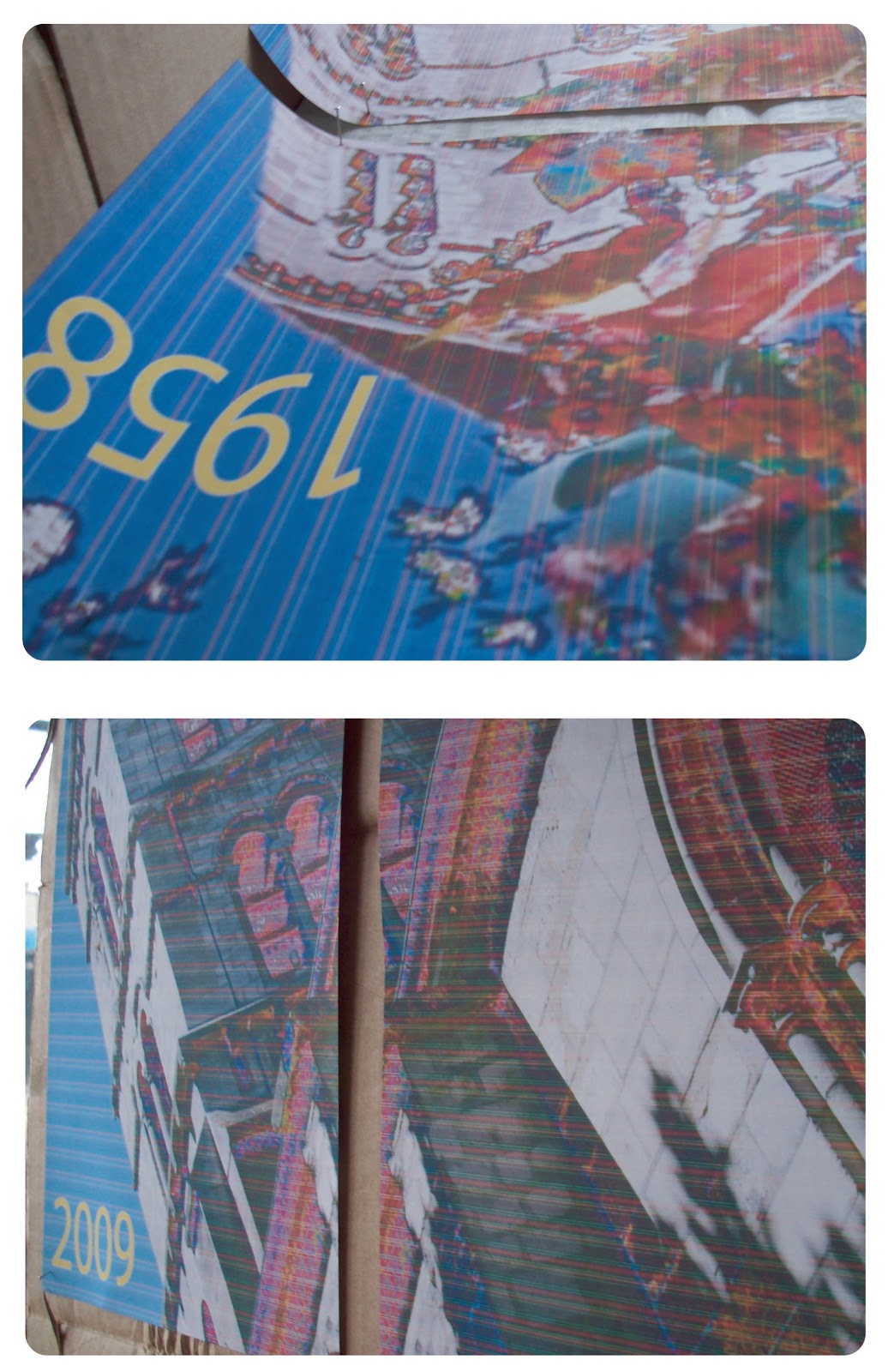
The photo above is a still from Tati’s 1958 film Mon Oncle. Below is a photo taken
of the same church in 2009. Mon Oncle is in part a comparison between the old
Paris, of Tati’s youth, and a Modern Paris of, perhaps, Le Corbusier. Old Paris
is represented by St Maur, a suburb of Paris to the east. The modern parts of
the film are sets, Play Time is
entirely a set.
I like to think of Tati, in some ways, as an
ethnographic film maker.

This is a still, a picture of the square in Mon Oncle at St Maur, which Tati
suggests, allows for a community engagement, if you like, it has a public space
with no motor cars, everything happens here from grocery shopping, to parties,
street fetes…

Above is recreation of the party scene in the Royal Garden Night Club at the end of Play Time
Tati
suggests that the modern architecture of Play Time has drained the life out of
the city. A vibrancy has been lost,
something vital.
Only
when the modern architecture comes apart do people start to move freely and
have fun.
Whereas
before they where abstracted and disconnected from their environment Tati
suggests they are now engaged bodily…
Louise Mackenzie_COPYRIGHT_2011
Subscribe to:
Posts (Atom)